

August “Gus” Holloway had a devastating choice to make. He sat in his car, not knowing what to do—all options led to a death of some kind. In his passenger seat sat a box containing three items: a blood-stained journal, an antique handheld mirror, and an ornate mahogany box inscribed with a scripture verse. The inscription said, “Be sure your sins will find you out. – Numbers 32:23.” The events leading up to this moment seemed to start innocently enough, but all the innocence had been bled from it years ago.
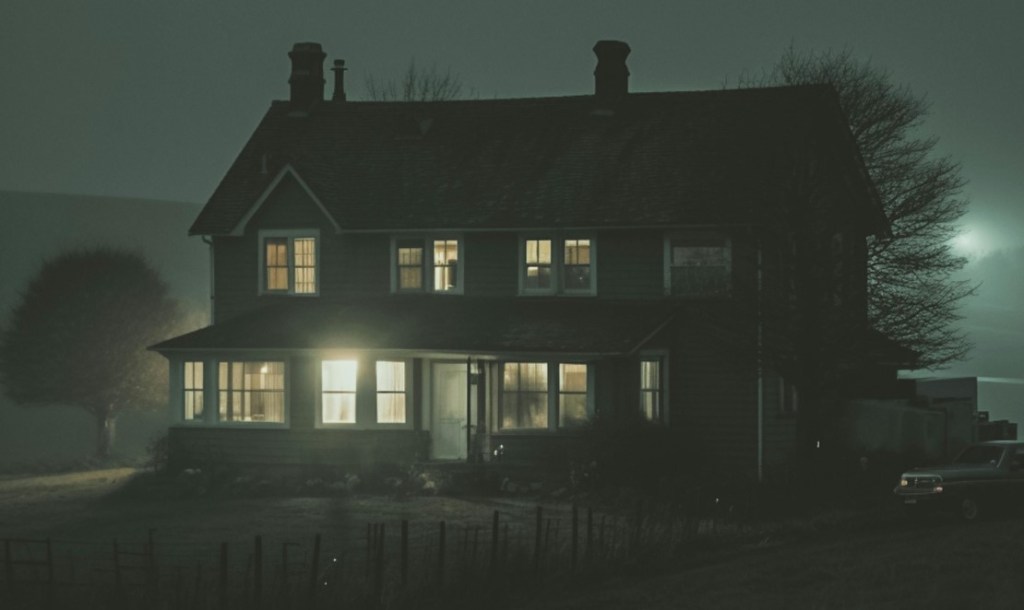
It was only earlier this week that he began renovating his new house. “New” is probably not the best word since the house was built in 1901. The first 70 years of its existence were innocuous, but what happened there in the 1970s allowed him to purchase the home for half the market value. He and his wife would still be stuck in the tiny apartment had it not been for its undesirability.
Gus knew the history of the place when he bought it. His wife advised him against it, but Gus hadn’t been much for listening to his wife for a while now. That was one of the remaining effects of years of moral compromise he had not yet come to recognize. August was raised in a Christian home and married a wonderful Christian woman, but years of secret sin come with a price tag.
He wanted to move to this new place to start over and rebuild his life—he kept that part hidden, even from his wife, because he didn’t want anyone to know it needed rebuilding. Despite not listening to his bride, he was doing this for her.
No one had lived in the house since 1978, but in the 16 years it had sat empty, it did not seem to age. When he turned the key and opened the door for the first time, the place looked dated but well-maintained—only the musty air spoke the truth.
Days later, the renovations began. His wife would continue living in the apartment while he would get the place ready. That is when he made the first discovery hidden in the basement wall—the box with the scripture carved on top. What was most peculiar was that the box seemed to have no opening. He thought, “If there are any sins hidden in here, no one is going to find them out.”
His mind went back 16 years to when the neighborhood was terrorized by someone, or something, called The Presence. They used that monicker because no one had ever seen whatever or whoever it was, but that didn’t stop The Presence from wreaking havoc in the lives of those he targeted. The only people to die in the ordeal were the husband and wife who lived in the house he had just bought at a steal. Since then, The Presence had disappeared, which led many to conclude that the husband who died in the house was the culprit.
Seeing the wooden box gave Gus a jolt of fear. It reminded him of his secret life—the secret life he thought he left behind. The box’s intricate pattern surrounding the verse was disorienting. The room seemed to spin every time he looked at it, even briefly. It felt like something had entered him and twisted around his soul.
The logistical problem with the box was not the scripture or its disorienting effect; it was that it could be evidence. August Holloway knew one thing: if this were new evidence pointing to The Presence, all renovations on his new place would halt as investigators began looking for new clues. Since August Holloway was a man of limited funds, he knew the delay would cause him to lose everything. The combined rent for his wife’s apartment and this new mortgage payment would drain the life from his account in only a few months. He needed to get this place ready quickly. The idea of concealing evidence while trying to turn a new leaf made his heart sink.
Averting his eyes to avoid nausea, Gus felt the weight of the wooden box in his hands and tried to explain his dilemma away. “This trinket was not evidence because there is no way the police would have missed it the first time.” Yes, he found it hidden behind a wall, and it would have been the kind of item The Presence would have used to torment his target, but Gus had heard that fire had damaged major portions of the house. During the investigation, walls were removed. Since the house came partially furnished, it likely belonged to the previous owners, fell between the floor joists, and landed between the basement wall during the remodel after the police left.
That is when he heard it—a knock at the door. Gus jumped, settled himself, went to the door, and opened it. The backlit man standing at the threshold was large, 6’3″ or 6’4″ at least, and his presence was ominous. Then he spoke. “Greetins’, I’m Abner Polk. I live across the street.” He spoke with a midwestern drawl, and his voice had a comforting, grandfatherly feel. He reached out his hand and gave Gus a warm handshake. Gus relaxed.
“I’m August Holloway, but everyone calls me Gus.”
“It’s a pleasure to meet ya, Gus. So yore’ the fella who bought this place. It’s good to have someone bring it back to life.”
“That’s me.” said Gus, “How long have you lived around here.”
“Since ‘1942. This was my wife and I’s first house, and we never left.”
“Well, it will be a pleasure to have folks like you as neighbors.”
“I guess I misspoke,” said Abner. “She moved on a couple of years ago. I lost her to Alzheimer’s.”
“I am sorry to hear that.” Gus felt like he had already grieved his neighbor. “I didn’t mean to…”
“Wouldn’t fret none about that. I’ve come to peace with it.
The last statement startled Gus. “Y’know, there’s things out there worse than dyin.” Gus’s mind immediately went to his secret life and the possibility of it coming to light.
Abner interrupted his thoughts. “I just wanted to stop by and introduce myself. I’ve been around for more than half of this house’s history. If ya have any questions, ya be sure to give me a holler.”
Gus’ eyes widened, realizing that ol’ Abner would have lived across the street when it all went down. He thought about the box but decided not to mention it.”
Abner looked at him carefully. “Ya found somethin,’ didn’t ya.”
Gus thought his poker face was perfect. “How did Abner know?”
“What would I find?” Gus replied. “I know about the history of this place; the realtors were required to tell me. Should I be looking for something related to that?”
Abner lost his grandfatherly demeanor. He became serious. “I won’t meddle, but if ya found somethin’ related to The Presence, know those thins’ have a way of carvin’ themselves into your soul.”
Gus thought, “Abe might not be the nice old man I thought he was.” It seemed like he was doing some soul carving of his own.
Gus closed the door, turned around, and saw the drawer of the wooden desk that came with the house partially open. He thought, “That desk drawer was closed just this morning. Who could have opened it? Abner never even left the front porch.”
He walked over, pulled open the drawer, and found a book—a journal of some kind. He picked it up and began to read.
“I am the owner of 1745 Hollow Bend Road, in Wendover, KS.”
Gus was startled. He thought, “This must be the journal of Clyde Mercer. He and his wife Francine were the two that were killed here.”
The journal continued, “What follows is an account of my dealings with The Presence. If you are reading this, it is because I am dead. I am making my confession to you now because I cannot do it while I am still alive.”
Page after page, Gus read of wrongdoings. From tax fraud, deception, and the betrayal of a friend, Clyde explained how all of these kept him trapped. He lived in constant fear of being found out. His journal entries also revealed how The Presence seemed to have witnessed every one of his sins and how accusations and vague threats of exposure haunted him. One specific story seemed to carry the most weight, and the page appeared a bit darker in color than the rest. It began.
“I can’t believe I am about to put this on paper. The mere act of doing this exposes me. There has been one temptation that has pulled me all my life. I have even tried to get rid of it, but it always comes back. Whenever I try to cast it out, I am left hollow, and it always seems to come back seven times stronger. I will confess my sin in detail on the next page, but it will ruin my life if anyone sees this before I die.”
Gus turned the page.
The page was unreadable. Insignificant words could be deciphered, but nothing of value was discernable. There seemed to have been some kind of struggle. It was as if a bloody hand landed squarely on the page and slid off. The remainder of the pages were blank.
That night, Gus could not sleep. The elements of Clyde’s life were too close to his own. Trapped by secret sin and unable to break free.
The next day, Gus walked across the street to talk to Abner. He knocked on the door.
Abner answered, “Mornin’ Mr. Holloway, I was expecting you.”
“Why were you expecting me?”
“Because when I saw you yesterday, you had the same look as Clyde Mercer a few days before he died.”
Gus became disoriented, like when he had looked at the wooden box.
“Woah, Ya better sit down there, Gus. You’re not lookin’ too hot.”
Gus regained his equilibrium. “What do you know about what happened to Clyde?”
“Everythin’,” Abner answered. “I was there.”
Gus’s stomach turned. He started to wonder if Abner was The Presence?’
“I know what you’re thinking. I am not behind this.”
“Then what happened?” The words coughed out of Gus’ mouth like it was driven by a disease.
Abner started. “Everything I am about to tell you, I told the police. They have never made it public record to protect the family’s privacy, so few others know about it.”
“Clyde was a good friend of mine, but he had been hiding something from me—he had been hiding things from everyone, even his wife.”
“Lemme tell ya—One day, Clyde found a wooden box with a Bible verse on top about sins finding you out. He went downhill fast. He was riddled with guilt and couldn’t shake it. He holed up in his basement fer’ about a month. We tried figurin’ out where the box came from because other things had appeared around the neighborhood. Strange things. Things that tore folks apart. They ruined marriages, ended careers, and even landed some people in jail.”
Gus’s anxiety spiked, and his stomach turned.
Abner continued, “The next thing Clyde found was an ol’ mirror. It was the kind the ladies use, made of fine wood, and looked ancient. Clyde looked into the glass. It was not his reflection he saw; it was a perversion of sorts. According to Clyde, it didn’t show him his face. It showed him his soul. He said what he saw was black, distorted, and horrifying. Clyde said what he saw in the mirror ‘seemed to have the devil’s fingerprints all over it.
“Wasn’t long after that he began to write a journal tellin’ the events. The night it happened was the night his wife found the book. Clyde saw her reading it and became frantic. He grabbed the mirror and struck her over the head. As soon as it connected, the mirror shattered, and a big ol’ shard of glass drove deep into his hand. His blood began to gush somethin’ fierce.”
Abner paused, “That is when I walked in.”
“I saw the smashed mirror on the floor and Clyde’s pierced hand. Franny was on the ground, barely conscious, and Clyde began hollerin’, ‘Only my blood can atone for my sins.’ He began flipping through his journal, looking for a specific page. He took his bloody hand and covered what he had written. I never did see what was on that page.”
Abner continued, “That is when I ran out to call the law. Their phone was dead as a doornail, so I ran across the street to use mine. As I was making the call, that was when I saw the flames pourin’ out of the basement window.”
Gus was horrified by the story, but one specific statement tormented him most of all. “Only my blood can atone for my sins.”
Gus asked, “So what happened to the box, the journal, and the mirror?”
“Burnt in the fire, I suppose,” Abner replied. ‘They never even found the glass from the mirror.”
“That is a tragic story,” Gus replied. “Clyde must have been in a terrible position. I hope I never find myself in a position like that.”
Abner said, “Well if you ever did, confession is good for the soul.”
Gus returned home, and on top of the desk, he saw the mirror. It looked charred and worn, but yet somehow still in good condition. Even the glass was intact. He refused to look into it and laid it facedown.
He tried to work the rest of the morning, but the mirror’s presence seemed to follow him. Maybe this was a joke Abner was playing on him. “No mirror can see into the soul,” he thought. “Even if it could, I am not all bad. I have done a lot of good things in my life.”
Gus walked over, picked it up, and stared directly into it. Nothing; all he saw was himself. He had bags under his eyes because he hadn’t slept, but it was just him. Then, ever so slowly, those bags began to droop lower—one side more than the other.
His eyes were no longer aligned, but he could not look away. As they separated, a crack formed in his flesh, and his skin began to fold away from his face. What he saw underneath was not flesh and bone. It wasn’t even physical. It was spiritual. It contained no light, only darkness, and it repulsed him. It was the same disorientation he felt when looking at the wooden box. He then understood that the evil of his heart gave the box and the mirror their power.
Abner’s words about his wife’s death came to Gus with new meaning. “Y’know, there’s things out there worse than dyin.” Clyde’s actions that night seemed to make sense to Gus. Maybe death is my only way out.” But something stopped Gus. “Maybe death is not the escape I think it is. What I saw in that mirror seemed like it would outlive my flesh. It did not look like it would die when my body folds away.”
“Gus!” “Gus!” Abner’s voice broke through the closed door. “There is one more thing you need to know. Clyde had another option.”
Abner’s voice came through the door again, urgent now. “Clyde had another option, Gus.”
Gus hesitated before opening the door. His hands were still trembling from what he had seen in the mirror. “What are you talking about?”
Abner looked at him solemnly. “Clyde thought his blood was the only thing that could atone for his sins—but that was a lie. There was already blood that had been shed for him.”
Gus’s stomach twisted. “You mean—”
“Yes,” Abner interrupted. “He could have confessed and trusted in the blood of the Savior. But he refused. He thought savin’ face was what mattered most. He didn’t think he could live with the consequences of his sin in this life. That’s why he ended things the way he did, but, even if he lost the whole world, he would have gained his soul.”
Gus felt the weight of those words pressing on him. The wooden box, mirror, and journal weren’t necessarily cursed objects. They were revealing what had been buried inside him all along.
And now he had a choice. He could go and confess to his wife and the police and lose it all, or he could keep it hidden and keep this world but lose his soul.
Gus sat in his car with the three items, still wondering what to do. That is when he heard it: the wooden box clicked open. He picked it up, lifted the lid, and found another verse carved inside.
“Whoever conceals his transgressions will not prosper, but he who confesses and forsakes them will obtain mercy. – Proverbs 28:13”
-D. Eaton
 The Fight of Faith
Wow …very, very excellent! Thnx.
Evy
pardon smartphone brevity/typos 🙂
LikeLiked by 1 person