

–By Rob Golding
The Christian life is one of rejoicing and rest. We celebrate the victory of our Lord over death each Sunday and rest in His final proclamation that “it is finished” (John 19:30). We then walk the simple path He set out for us as He says, “Come to Me … For my yoke is easy, and my burden is light” (Matt 11:28a, 30). But many Christians find themselves so filled with rest and rejoicing that they are overweight, spiritually and physically lethargic, and mentally delayed. Is this what Christ intended?
On the other hand, many secular people spend much time and energy figuring out how they can discipline themselves in order to “optimize” their performance in this life. People like Andrew Huberman, Joco Wilnick, David Goggins, and Joe Rogan are constantly amending their diets, tweaking their exercise regimens, and sharpening their minds. Why? In order to better perform the various tasks that they find themselves doing. For the secular person, their work has no eternal value. Joe Rogan practices “extreme” discipline in order to be a better podcast host. David Goggins constantly exercises with herculean effort in order to be better at … exercising. On the other hand, Christians enjoy the immensely important call to follow after Christ with all their hearts so that they can participate in the building of His kingdom. Yet, our diets are often very poor (just examine the food laid out at your church this Sunday), and our bodies are regularly burdened with the deposits of overeating and under-exercising. Is this what Christ intended?
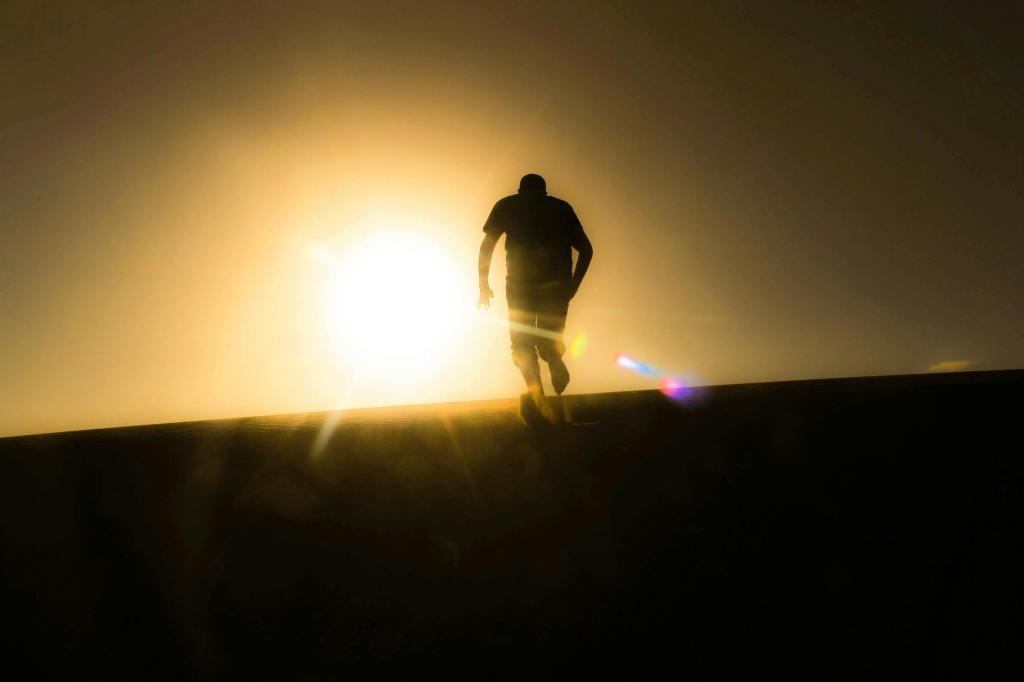
The Apostle Paul paints a strikingly different picture. Rather than describing us as Christians just waiting for the return of Christ, we are runners in a race seeking a prize: “Do you not know that in a race all the runners run, but only one gets the prize? Run in such a way as to get the prize” (1 Cor 9:24). The word “race” in Greek is stadion (στάδιον) which means literally, as you might guess “stadium.” Hence, the CSB (and only the CSB for some reason) has “the runners in a stadium all race.” Paul is saying that not only are we in a race in which we run after Christ, but that there are countless people watching us (cf. Heb 12:1-2). Furthermore, we are pursuing not just some perishable reward like a world-class podcast or top-dog physical performance but salvation in Christ. What could be a better motivation for self-discipline?
In order to run after this salvation in Christ, Paul says, “I strike a blow to my body and make it my slave” (1 Cor 9:27a). Yes, Paul vehemently disciplines his body—so much so that he uses violent imagery to describe it—in order that he may receive the “prize” of Christ. This prize isn’t just being a better Christian than a “lazy” Christian, but it is salvation itself (see Phil 3:12-14 which uses the same Greek word for “prize”). That is, the reason Paul exercises extreme discipline over his body is “so that after I have preached to others, I myself will not be disqualified for the prize” (1 Corinthians 9:27). To be disqualified in the Christian race is to be disqualified for heaven. Paul uses the same Greek word (“disqualified,” adokimos, ἀδόκιμος) in 2 Corinthians 13:5-7 in order to warn the Corinthians that they may “fail the test” (adokimos, ἀδόκιμος) and will therefore “appear disapproved” (adokimos, ἀδόκιμος). The discipline of our bodies, according to Paul, is for no other reason than to ensure that we will not be rejected by Christ on the last day.
Of course, Jesus’s standard isn’t the body-mass index or how many pushups we can do. That is ridiculous. Paul’s point is that the physical discipline he endures is for the purpose of “fighting the good fight of faith.”
Some may object that such discipline is agonizing. And? Paul says that “everyone who competes in the games goes into strict training” (1 Cor 9:24). The words, “competes in the games” is one Greek word: agonizomai (ἀγωνίζομαι). This is the word we get “agonize” from. The “training” and the “competing” of people like Joe Rogan is usually described using the same word—agonizing. “It was a brutal workout; my diet is killing me,” etc. If they’re willing to go through the agony of training for such trifling things, shouldn’t we do the same when the prize of Christ is on the line? The great hymn writer Isaac Watts asked the same question:
“Must I be carried to the skies
On flowery beds of ease,
While others fought to win the prize
And sailed through bloody seas?”
Interestingly, when Paul tells us to “fight the good fight of faith” (1 Tim 6:12), the Greek word for “fight” is, again, agonizomai (ἀγωνίζομαι). The fight of faith often feels like agony. Yes, we rest in Christ’s finished work and take up His easy yoke, but the way we do this is through blessed activity, not blessed inactivity. “It is finished” doesn’t mean “take a nap.” Heaven isn’t just one big siesta. God is the God of constant activity; theologians call this His being actus purus, or always acting and never needing a recharge. The way that we are enabled to endure the “agony” of the fight is by looking to Christ, the Captain of our Army. When we do that, when we look to His beautiful love for us in His bloody and triumphant work, our bodies—not just our souls—are invigorated with life such that the discipline of Christianity becomes a light burden. This is why the martyrs were able to sing songs of glorious thanksgiving as they were being burned alive. It was not that their deaths were easy but that Christ made them stronger than death.
How do we get there? We begin by disciplining our bodies so that we are better able to follow after Christ. We get more fit, read more and watch less, go to Church more, are watchful, and pray. When we do these things as part of a spiritual regimen, we slowly become more like grown men and less like little boys. We become people who don’t need to binge-watch Netflix to recover from a tough week because we’re strong enough to handle the week. And, when we fail into a tub of ice cream and too many episodes of Ted Lasso, we repent, get up, and continue on after Christ, who forgives much worse transgressions than these. This is why Paul said, “Be watchful, stand firm in the faith, act like men, be strong” (1 Corinthians 16:13).
-Rob Golding – Pastor, First Artesia CRC

